

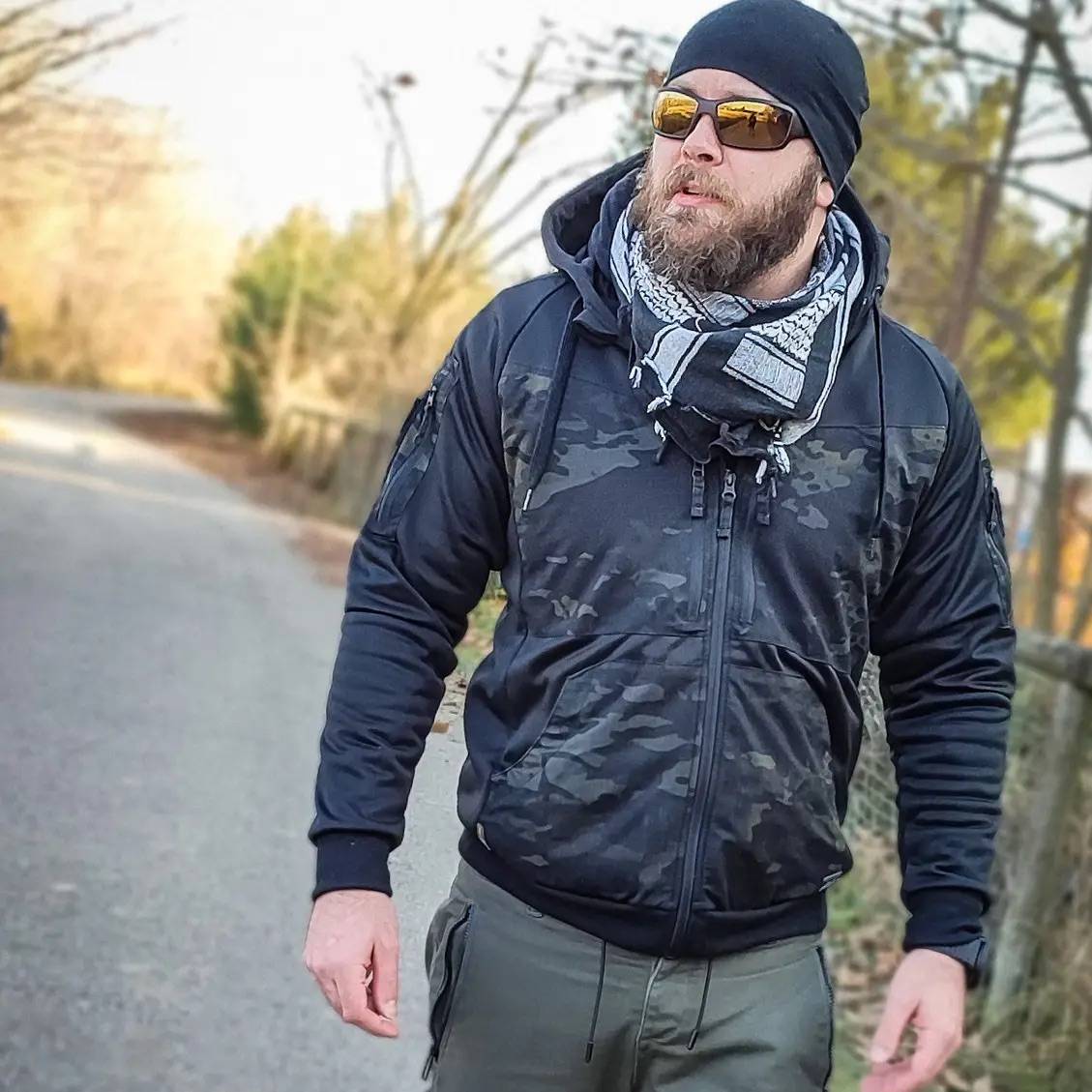

Infantry Jacket Fleece Black / PL Woodland

- Schweres Fleece mit 380 g/m²
- Schultern und Ellbogen verstärkt
- Für kühle Einsätze
Tax included. Shipping calculated at checkout


Size chart

How to measure yourself?
1. Chest circumference
Measure your chest at the widest point, holding the tape horizontally.
2. Waist circumference
Measure your waist without holding too tightly or too loosely.
3. Hip circumference
Measure the circumference at the widest point of your hips without holding too tightly or too loosely.
4. Inseam length
Measure the inside of the leg in a straight line, measuring from the crotch to the ankle.
5. Height
Measure your height standing against a wall in a natural, upright position.
| Measurement | XS | S | M | L | XL | 2XL | 3XL | 4XL |
| Chest circumference | 87-92 | 93-98 | 99-104 | 105-110 | 111-116 | 117-122 | 123-128 | 129-134 |
| Waist circumference | 71-76 | 77-82 | 83-88 | 89-94 | 95-100 | 101-106 | 107-112 | 113-118 |
| Hip circumference | 85-90 | 91-96 | 97-102 | 103-108 | 109-114 | 115-120 | 121-126 | 127-132 |
| Short | Regular | Long | X-long | |||||
| Inseam length | 73-77 | 78-82 | 83-87 | 88-92 | ||||
| Height | 168-176 | 176-182 | 182-190 | 190-200 |


Shipping and Returns
Free shipping from €149 (DE, AT)
30-day return policy
incl. buyer protection
incl. insured shipping
DESCRIPTION
Fleece jackets may look similar at first glance, but in practice, they differ significantly in terms of warmth, ventilation, and pack size. The Infantry Jacket Fleece black / pl woodland is a heavy, reinforced fleece jacket designed for intensive use and high heat retention. The Infantry Fleece has a deliberately classic and robust design. With 380 g/m² Heavy Fleece, it is one of the warmest Helikon-Tex fleece jackets and also features reinforced shoulder, elbow, and forearm areas. This makes it an attractive choice for those who frequently wear backpacks, often put on and take off equipment, or are generally exposed to high mechanical stress in their daily routine. Unlike hooded models, the Infantry relies on a high, reinforced collar and a clear, functional pocket layout. The Black / PL Woodland version intentionally features a striking pattern; technically, it follows the same basic construction as the rest of the model family, unless otherwise stated in the technical specifications.
What is the Infantry Jacket Fleece black / pl woodland suitable for?
This model is particularly sensible if you choose a fleece jacket based on your activity level rather than just as an arbitrary warm layer. Typical applications include:
- cool to cold days with moderate movement intensity
- outdoor work, training, and long periods spent outdoors
- as a strong insulating layer under a windproof or waterproof outer jacket
- users who prefer reinforcements and a high collar over a hood
Material, warmth, and layering system
Fleece provides insulation by trapping air within its brushed or structured surface. At the same time, polyester can transfer moisture more quickly and generally dries faster than cotton. The downside: classic fleece is relatively wind-permeable and not waterproof without additional construction. In stronger winds or persistent rain, it is therefore necessary to wear a windproof or hardshell jacket over it, depending on the model. For an effective layering system, the base layer should wick moisture away from the skin, the fleece should retain heat, and the outer layer should only be as dense as the weather strictly requires. Too many dense layers can otherwise create unnecessary heat accumulation during physical activity.
- 380 g/m² Heavy Fleece provides high insulation but is significantly bulkier than grid or hybrid fleece.
- Nylon reinforcements on shoulders, elbows, and forearms increase abrasion resistance.
- Four YKK® pockets: two hip pockets, a chest pocket, and a shoulder pocket.
- High collar, adjustable cuffs, and a drawstring hem reduce heat loss.
- Two-way front zipper with storm flap facilitates ventilation and access.
Pockets, ventilation, and practical use
With a fleece jacket, the number of pockets alone is not very informative. What matters is whether pockets remain accessible under a backpack hip belt, whether heavy items bounce while walking, and how quickly you can get rid of excess heat. Therefore, load large pockets with lighter items like gloves, a hat, or a smartphone, and distribute heavier small items as close to the body as possible. If you are wearing a backpack, also check whether shoulder reinforcements, zippers, and pockets lie exactly under the straps or remain freely accessible.
Practical tip: Always evaluate the jacket in combination with your usual layers. A fleece jacket that fits perfectly over a T-shirt might be too tight over a base layer and a shirt; conversely, too much extra space creates unnecessary air and volume under a hardshell. During high activity, it is better to ventilate or remove a layer early rather than reacting only after the clothing has already become damp.
Terms explained and selection guide
- Heavy Fleece: particularly dense and heavy fleece with high heat retention. It insulates better but requires more packing space and is more wind-permeable than a true softshell.
- Grammage: the surface weight of the fabric in g/m². For similar constructions, a higher value usually indicates more material and warmth, but it is not a sole guarantee of temperature suitability.
- Reinforcement zones: additional abrasion-resistant material patches on high-stress areas like shoulders and elbows.
- Two-way zipper: a front zipper with two sliders. It can also be opened from the bottom, for example, when sitting down or for increased ventilation.
Selection note: The Infantry is a sensible choice if robust reinforcements and high warmth are more important to you than low weight. The Alpha Tactical is lighter and more breathable; the Classic Army is slightly less heavy; the Patriot Mk2 offers more pockets and a hood.
Furthermore, a fleece jacket is not a temperature guarantee. How warm it feels depends on wind, humidity, movement, undergarments, and individual sensitivity to cold. Therefore, material thickness and weight are good comparative values but do not replace proper layer planning.
Technical data
- Main material: 100% polyester
- Material type: Heavy Fleece, 380 g/m²
- Weight: approx. 1,008 g in reference size L
- Pockets: 4
- Reinforcements: shoulders, elbows, and forearms
- Hood: no
- Closure: two-way YKK®
- Manufacturer: Helikon-Tex
- Color / Pattern: Black / PL Woodland
Properties
Material : 100% Polyester
Dimensions:
Weight:990g
Volume:
Color:black / pl woodland
GPSR Product Safety
Manufacturer Information:
Fleece jackets may look similar at first glance, but in practice, they differ significantly in terms of warmth, ventilation, and pack size. The Infantry Jacket Fleece black / pl woodland is a heavy, reinforced fleece jacket designed for intensive use and high heat retention. The Infantry Fleece has a deliberately classic and robust design. With 380 g/m² Heavy Fleece, it is one of the warmest Helikon-Tex fleece jackets and also features reinforced shoulder, elbow, and forearm areas. This makes it an attractive choice for those who frequently wear backpacks, often put on and take off equipment, or are generally exposed to high mechanical stress in their daily routine. Unlike hooded models, the Infantry relies on a high, reinforced collar and a clear, functional pocket layout. The Black / PL Woodland version intentionally features a striking pattern; technically, it follows the same basic construction as the rest of the model family, unless otherwise stated in the technical specifications.
What is the Infantry Jacket Fleece black / pl woodland suitable for?
This model is particularly sensible if you choose a fleece jacket based on your activity level rather than just as an arbitrary warm layer. Typical applications include:
- cool to cold days with moderate movement intensity
- outdoor work, training, and long periods spent outdoors
- as a strong insulating layer under a windproof or waterproof outer jacket
- users who prefer reinforcements and a high collar over a hood
Material, warmth, and layering system
Fleece provides insulation by trapping air within its brushed or structured surface. At the same time, polyester can transfer moisture more quickly and generally dries faster than cotton. The downside: classic fleece is relatively wind-permeable and not waterproof without additional construction. In stronger winds or persistent rain, it is therefore necessary to wear a windproof or hardshell jacket over it, depending on the model. For an effective layering system, the base layer should wick moisture away from the skin, the fleece should retain heat, and the outer layer should only be as dense as the weather strictly requires. Too many dense layers can otherwise create unnecessary heat accumulation during physical activity.
- 380 g/m² Heavy Fleece provides high insulation but is significantly bulkier than grid or hybrid fleece.
- Nylon reinforcements on shoulders, elbows, and forearms increase abrasion resistance.
- Four YKK® pockets: two hip pockets, a chest pocket, and a shoulder pocket.
- High collar, adjustable cuffs, and a drawstring hem reduce heat loss.
- Two-way front zipper with storm flap facilitates ventilation and access.
Pockets, ventilation, and practical use
With a fleece jacket, the number of pockets alone is not very informative. What matters is whether pockets remain accessible under a backpack hip belt, whether heavy items bounce while walking, and how quickly you can get rid of excess heat. Therefore, load large pockets with lighter items like gloves, a hat, or a smartphone, and distribute heavier small items as close to the body as possible. If you are wearing a backpack, also check whether shoulder reinforcements, zippers, and pockets lie exactly under the straps or remain freely accessible.
Practical tip: Always evaluate the jacket in combination with your usual layers. A fleece jacket that fits perfectly over a T-shirt might be too tight over a base layer and a shirt; conversely, too much extra space creates unnecessary air and volume under a hardshell. During high activity, it is better to ventilate or remove a layer early rather than reacting only after the clothing has already become damp.
Terms explained and selection guide
- Heavy Fleece: particularly dense and heavy fleece with high heat retention. It insulates better but requires more packing space and is more wind-permeable than a true softshell.
- Grammage: the surface weight of the fabric in g/m². For similar constructions, a higher value usually indicates more material and warmth, but it is not a sole guarantee of temperature suitability.
- Reinforcement zones: additional abrasion-resistant material patches on high-stress areas like shoulders and elbows.
- Two-way zipper: a front zipper with two sliders. It can also be opened from the bottom, for example, when sitting down or for increased ventilation.
Selection note: The Infantry is a sensible choice if robust reinforcements and high warmth are more important to you than low weight. The Alpha Tactical is lighter and more breathable; the Classic Army is slightly less heavy; the Patriot Mk2 offers more pockets and a hood.
Furthermore, a fleece jacket is not a temperature guarantee. How warm it feels depends on wind, humidity, movement, undergarments, and individual sensitivity to cold. Therefore, material thickness and weight are good comparative values but do not replace proper layer planning.
Technical data
- Main material: 100% polyester
- Material type: Heavy Fleece, 380 g/m²
- Weight: approx. 1,008 g in reference size L
- Pockets: 4
- Reinforcements: shoulders, elbows, and forearms
- Hood: no
- Closure: two-way YKK®
- Manufacturer: Helikon-Tex
- Color / Pattern: Black / PL Woodland
Material : 100% Polyester
Dimensions:
Weight:990g
Volume:
Color:black / pl woodland
Manufacturer Information: